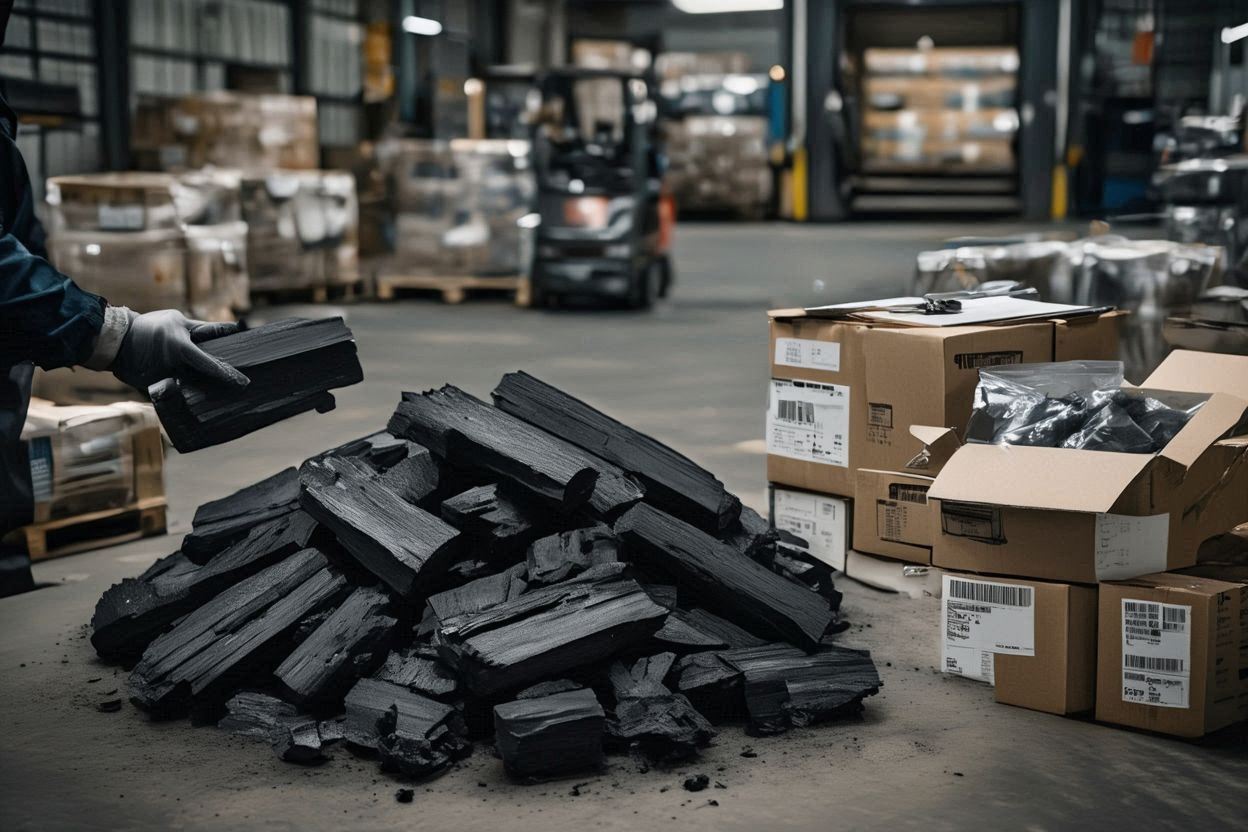
Premium coconut shell charcoal for export has become a highly demanded product in international markets due to its consistent quality, high carbon content, and environmentally responsible production process. As a result, global industries and consumers increasingly prioritize clean energy and sustainable materials, while premium coconut-based charcoal continues to gain strong export potential.
Moreover, manufacturers produce this charcoal from carefully selected coconut shells using controlled carbonization techniques. Through this process, a dense carbon structure with stable performance is created. Therefore, the product suits export markets that require strict quality standards and reliable specifications.
High-Quality Raw Materials for Export-Grade Charcoal
First and foremost, the foundation of export-grade charcoal starts with raw material selection. Producers actively choose mature coconut shells because they naturally contain high carbon levels and strong shell density.
Afterward, workers clean and dry the shells to remove moisture and impurities. In doing so, this preparation stage improves carbon consistency and helps ensure the finished product meets international export requirements.
Controlled Carbonization for Premium Performance
Equally important, carbonization plays a critical role in producing premium charcoal for export. During this stage, manufacturers carefully control temperature and airflow to preserve pore structure and carbon purity.
As a result, the charcoal delivers stable burning behavior, low ash content, and predictable performance. Consequently, these characteristics make the product suitable for demanding global applications.
Performance Advantages in Global Markets
In practice, premium coconut shell charcoal offers several performance benefits that attract international buyers. Its dense structure allows longer burning time and consistent heat output.
In addition, low smoke and minimal odor improve user experience across various applications. Therefore, export markets value this charcoal for its reliability and clean combustion properties.
Applications Driving Export Demand
Notably, export demand for premium coconut charcoal spans multiple sectors. In food-related industries, buyers prefer it for grilling and roasting because it provides stable heat without affecting flavor.
Meanwhile, industrial users rely on coconut-based charcoal for filtration, adsorption, and processing systems. Because of this versatility, its position in global trade markets continues to strengthen.
Export Standards and Quality Control
To ensure compliance, producers implement strict quality control systems to meet export standards. They monitor moisture content, ash levels, fixed carbon percentage, and particle size consistency.
Furthermore, screening and grading processes ensure uniformity. Consequently, buyers receive products that comply with international specifications and shipping requirements.
Sustainable Production and Environmental Responsibility
From a sustainability perspective, coconut shells originate from renewable agricultural byproducts. By converting these shells into charcoal, manufacturers reduce waste and support responsible resource utilization.
Moreover, modern production facilities focus on energy efficiency and emission control. As a result, premium coconut shell charcoal for export aligns well with global sustainability expectations.
Choosing a Reliable Export Charcoal Supplier
Ultimately, selecting the right supplier plays a key role in successful export transactions. Buyers should evaluate production capacity, quality assurance practices, and export experience.
For this reason, buyers seeking detailed product specifications and export-ready charcoal solutions can visit premium coconut shell charcoal to explore quality standards and international applications.
Verified Export Resources and Product Information
Additionally, access to verified information helps buyers assess production reliability and supply capabilities. Comprehensive product and service details are available at sewcazual.com, which provides insights into premium charcoal solutions for global markets.
Conclusion
In conclusion, premium coconut shell charcoal for export continues to play an important role in international trade by offering consistent quality, sustainable sourcing, and reliable performance. Through careful processing, strict quality control, and responsible production methods, coconut shell–based charcoal remains a trusted export commodity for global buyers.


Related Posts

Teknologi Pertanian Modern Padi untuk Produktivitas Maksimal

Analisa Usaha Jasa Panen untuk Peluang Menguntungkan